BitMEX and Perpetual Contracts: How a Contract Changed Crypto Derivatives Trading
Data verification time: July 28, 2026
Risk Warning: Perpetual contracts are high-risk derivatives. Leverage not only amplifies profits, but also amplifies losses. Trading fees, funding rates, slippage, and forced liquidation mechanisms may all affect the final result. This article is only used to introduce the product mechanism and industry history, and does not constitute investment advice.
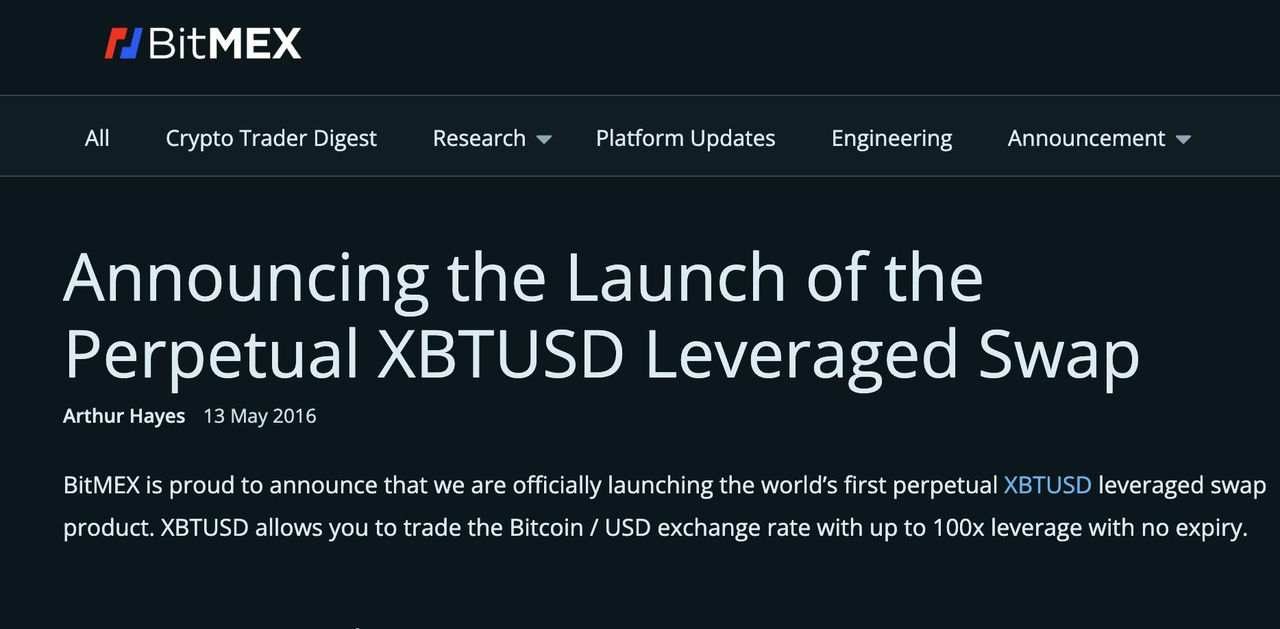
BitMEX launched the XBTUSD perpetual swap in 2016. It has no fixed expiration date and can be traded with high leverage, quickly becoming one of the most representative products in the cryptocurrency derivatives market.

Table of Contents
- Why does the cryptocurrency market need perpetual contracts?
- What contract is XBTUSD exactly?
- How to keep up with spot prices without an expiration date
- Why is 100x leverage so popular?
- What will happen to XBTUSD after BitMEX closes?
- Why does the cryptocurrency market need perpetual contracts?
Traditional futures have expiration dates. Traders who want to continue holding positions in the same direction need to close their old positions before the contract expires and then switch to a new contract, which is commonly known as moving positions or rolling over.
This method is common in traditional Financial Marekt, but it may not be convenient in the year-round crypto market. Users not only need to remember the settlement date, but also may face price differences and transfer costs between contracts of different maturities.
On May 13, 2016, BitMEX launched XBTUSD. It has no fixed expiration date, and users can continue to hold positioning as long as they have enough margin. They can also use up to 100 times leverage to trade bitcoin prices.
However, “perpetual” does not mean that positioning will never end. Users can actively position squaring, and may also be forced to position squaring when the margin is insufficient. What it really cancels is only the pre-set expiration and settlement dates of traditional futures.
When XBTUSD was first launched, not everyone could understand it immediately. Especially the funding rate, which was still a new concept for crypto traders at that time. As trading volume increased, this product gradually became accepted by the market and widely adopted by other trading platforms.
- What kind of contract is XBTUSD?
Users can enter on the BitMEX web page.
Trade → Perps → XBTUSD
View the transaction page.
When you need to check the complete parameters, you can enter:
Contract List → XBTUSD → Contract Specification
The Contract Details area on the transaction page also displays the current funding rate and the next funding settlement time.
As of July 28, 2026, the main specifications of XBTUSD are as follows:
| Project | XBTUSD Specifications |
| Contract type | Reverse perpetual contract |
| Subject matter | Bitcoin against the US dollar |
| Quotation currency | USD |
| Margin and profit and loss settlement | BTC, BitMEX code is XBT |
| Value per contract | Bitcoin equivalent to 1 US dollar |
| Fixed maturity date | None, but may settle in advance |
| Maximum initial leverage | 100 times |
| Base initial margin | 1.00% |
| Basic Maintenance Margin | 0.50% |
| Minimum transaction amount | $100 |
| Order quantity unit | 100 sheets |
| Minimum price change | 0.1 USD |
| Maximum single order quantity | 10,000,000 sheets |
| Funding cost cycle | Every 8 hours |
| Ordinary order fee | 0.05% |
| Ordinary meal fee | 0.05% |
XBTUSD is quoted in US dollars, but it is not a token that can be transferred to a wallet, nor does it have ERC-20, TRC-20, or other blockchain networks.
It is just a derivative contract within the BitMEX platform. Users use BTC as margin, and the trading results are also calculated in BTC. Each contract represents 1 USD equivalent of Bitcoin, and the current minimum trading amount is $100, so the order quantity starts from 100.
The base rate for pending and eating orders for regular accounts is currently 0.0500%. The actual rate for users may vary due to different 30-day trading volume, VIP level or other account conditions. Before trading, you should confirm it again on the My Fees page of your personal account.
Here we need to distinguish between two types of costs:
- Transaction fee : paid to the platform when the order is completed;
- Funding costs : Regular payments between bulls and bears.
The two are not the same thing.
- How to keep up with spot prices without an expiration date?
When traditional futures approach maturity, prices usually gradually approach spot prices. Perpetual contracts do not have a settlement date, so another way is needed to avoid long-term price deviations.
BitMEX uses a funding fee mechanism.
When the price of XBTUSD is higher than the reference spot index, the funding rate is usually positive, and bulls pay fees to bears. The cost of long positions increases, and short positions are more attractive, which helps to pull the contract price back towards the spot direction.
Conversely, when the XBTUSD price is lower than the spot index, the funding rate may become negative, and the bears pay fees to the bulls, encouraging the market to buy.
BitMEX usually settles fund fees every 8 hours, corresponding to daily:
- 04:00 UTC;
- 12:00 UTC;
- 20:00 UTC。
Only users who still hold positions at the settlement time will pay or receive this fee. Users who position squaring in advance will not be charged proportionally based on the holding time.
The basic calculation method for capital costs is:
Funding cost = Funding rate × Positioning nominal value
This money was not collected by BitMEX, but was transferred between bulls and bears. BitMEX is responsible for calculation and execution, but does not take a cut from the funding fees.
It should be noted that the capital cost is calculated based on the nominal value of positioning, not the actual margin invested by the user. High leverage and large positioning may quickly consume the remaining margin when encountering persistently high capital rates, and in severe cases, may even increase the risk of forced liquidation.
- Why is 100x leverage so popular?
One of the most eye-catching features of XBTUSD when it went online was the maximum leverage of 100 times.
Users can control a larger nominal positioning with less margin. For short-term trading, hedging, and cross-platform arbitrage, this greatly improves the efficiency of capital utilization and allows users to go long or short on Bitcoin without holding equivalent spot.
However, the higher the leverage, the smaller the reverse fluctuation that positioning can withstand.
The initial margin for XBTUSD is 1%, which does not necessarily mean that the price will be liquidated after a 1% reverse fluctuation. The true liquidation price will also be affected by the following factors.
- Maintenance Margin;
- Opening position and trading fees.
- Funding rate;
- Mark the price;
- Positioning mode;
- Remaining balance in the account.
The changes brought by BitMEX are not just about “leveraging up to 100 times”.
It combines a whole set of mechanisms together.
- The contract has no fixed expiration date.
- Use funding rates to connect contracts and spot prices.
- Support all-weather long and short positions.
- Use marked prices to manage forced liquidation.
- Improve fund efficiency through margin.
- Consolidate transactions into a core perpetual contract.
BitMEX also offered multiple maturities of Bitcoin futures in the early days, but liquidity was easily dispersed. XBTUSD has no expiration date, and a large number of transactions can be concentrated in the same market for a long time, which is also an important reason why it can later become a core product.
- What will happen to XBTUSD after BitMEX closes?
BitMEX has announced that the exchange will cease operations at 04:00 UTC on September 23, 2026 .
Starting at 04:00 UTC on August 26th , the platform will implement risk restrictions. At that time, users cannot add new positioning, only reduce existing positioning. During the period from August 26th to the final closure, BitMEX may also gradually close some unposition squaring positions.
By September 23rd, the unprocessed positioning will be forcibly position squaring by the platform.
This also indicates that although perpetual contracts do not have a preset expiration date, it does not mean that they can exist for a long time without the exchange. The contract specifications of XBTUSD itself also indicate that it belongs to perpetual contracts, but may be settled in advance.
BitMEX has announced that some derivative contracts with insufficient trading interest will be taken down before the final closure. Therefore, holders should not only remember September 23rd, but also check:
- XBTUSD contract page;
- BitMEX delisting announcement;
- Actual position status in the account.
- Subsequent notification from the platform.
For a complete closing timeline, account access, and funding arrangements, please refer to:
“BitMEX is about to close: What does it mean for your account and funds?”
After the closure of BitMEX, perpetual contracts will not disappear from the market. Nowadays, many cryptocurrency derivative platforms are using similar mechanisms. The withdrawal of BitMEX only means that the early promoters of this product have stopped operating, and does not mean that perpetual contracts themselves have lost their effectiveness.
Summary
BitMEX launched XBTUSD in 2016, putting no expiration date, funding rate, BTC settlement, and up to 100x leverage into the same contract.
It reduces the problem of frequent position shifting in traditional futures and allows a large amount of liquidity to be concentrated in a core market for a long time. The impact of XBTUSD can be seen in the funding rate, no expiration date, and all-weather trading mechanism widely adopted by other platforms.
However, the fact that perpetual contracts have no expiration date does not mean there is no end. BitMEX will cease operations on September 23, 2026, and the existing XBTUSD positioning also needs to be processed before the platform shuts down. Holding cannot wait for the exchange to close.
FAQs
Who invented perpetual contracts?
In the cryptocurrency trading market, BitMEX launched XBTUSD in 2016 and called it the first perpetual leveraged swap for Bitcoin against the US dollar. A more secure statement is that BitMEX has promoted the productization and popularization of perpetual swaps in the cryptocurrency market.
Is XBTUSD a type of Bitcoin?
No. XBTUSD is a perpetual derivative contract for Bitcoin against the US dollar, not a token that can be transferred to an external wallet. It is quoted in US dollars and settled in BTC as a margin and profit and loss asset.
What is the difference between XBTUSD and XBTUSDT?
XBTUSD is a reverse contract, usually settled in BTC; XBTUSDT is a linear contract, usually using USDT as margin and settlement asset. The margin changes and profit and loss calculation methods of the two contracts are different.
Is the funding rate the handling fee charged by BitMEX?
No. The funding fee is paid by the bulls and bears to each other, and BitMEX does not take a cut. The pending order fee and the eating order fee are the transaction fees paid to the platform when the order is completed.
Will XBTUSD positioning be automatically transferred to other exchanges after BitMEX is closed?
No. BitMEX has not announced the arrangement for automatic migration positioning. Users need to handle positioning themselves. Positions that have not been processed on September 23rd will be forcibly closed by the platform.
Suggestions for pictures
Picture 1: BitMEX 2016 XBTUSD Online Announcement
Placement position: after the beginning of the answer paragraph.
Image caption: BitMEX released the XBTUSD perpetual leveraged swap in May 2016.
Alt text: Official announcement of BitMEX launching the XBTUSD perpetual contract in 2016.
Image 2: XBTUSD Real Contract Specification Page
Placement position: “What kind of contract is XBTUSD?” section.
Screenshot highlights: 100x leverage, $1 contract value, BTC settlement, minimum transaction amount, and funding fee cycle.
Alt text: BitMEX XBTUSD contract specifications, leverage, and minimum trading amount.
Picture 3: BitMEX XBTUSD Real Trading Interface
Placement position: “Why is 100x leverage so popular” section.
Image description: BitMEX XBTUSD trading page, including order book, candlestick, positioning, and contract details.
Alt text: BitMEX XBTUSD perpetual contract real trading interface.
Picture 4: BitMEX official shutdown announcement
Placement location: “What will happen to XBTUSD after BitMEX is closed” section.
Screenshot highlights: Risk restrictions on August 26th and final closure time on September 23rd.
Alt text: Risk limits and final closure date in BitMEX closure announcement.